
Agnihotra in Bali: Fire, Sunrise, and the Ritual of Remembering
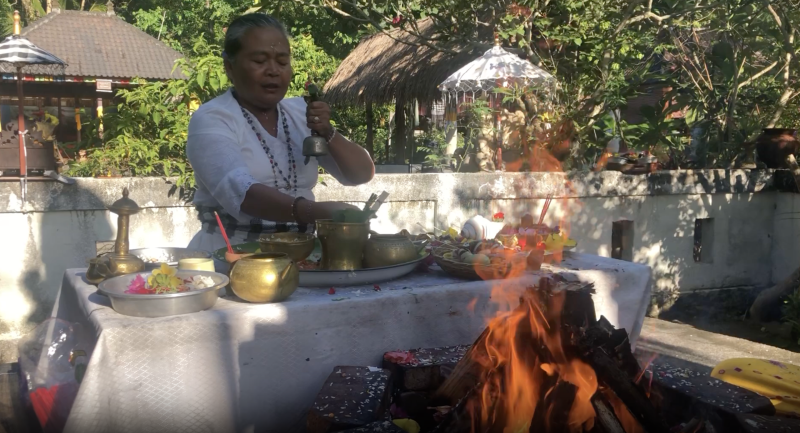
One of the things I love most about Bali is fire.
Not a beach bonfire, I mean a small, careful flame at the heart of a ceremony, smoke curling upward while a priest chants beside it. The first time I sat at one, I’ll be honest, part of me was doing the math: a little fire, some rice, a copper pot, a few old words. What’s the big deal? And then I sat there a while longer, and the fussy, list making part of my brain went quiet, and something else took over. A softness in the chest I hadn’t felt all day. I didn’t understand all of it. I still don’t. But I understood what happened in my own body: I got quiet. Turns out the ritual has a name, and it’s about as old as ritual gets: Agnihotra sometimes written Agni Hotra.
Agni means fire. Hotra means making an offering. So we make an offering to Lord Agni. Simple as that.
But why fire? Here’s the part I love. Fire isn’t only the flame in the pot, it’s the light of God inside us, the warm spark of consciousness that keeps us alive. As long as you’re still warm, the fire is still burning in there. Krishna says as much to Arjuna in the Gita: “Aham Vaishvanaro Bhutva” — “I am Vaishvanara,” another name for Lord Agni. The fire in the pot and the fire in you are the same fire. The ceremony is just a way of remembering that.
Your body is already the temple
This is the part that undid me a little.
You’d think you’d need a grand temple to make an offering to God. But the teaching says your own body is the temple: Deho Devalayah Proktah – “the body is called a temple,” the dwelling place where God already lives. We’re not summoning anything from far away. The fire we tend in the pot is a mirror of the one that’s been lit inside us all along. The work isn’t to acquire something holy. It’s to remember what’s already here.
That, to me, is the whole thing in a sentence. So much of our suffering comes from believing we’re empty and have to go get filled. This ritual says the opposite: you were never empty. Sit down. Remember.
Why sunrise and sunset?
Here’s the part that gave me chills. Agnihotra, an offering of fire named in the Vedas, with roots reaching back into a Vedic world older than Buddhism, is done exactly at sunrise and exactly at sunset. The two moments each day when the light itself changes gears: the instant the first ray touches where you’re standing, and the instant the last ray leaves. The old texts called these the rhythm of nature.
You don’t have to believe a word of the metaphysics to feel why this settles something in us. When was the last time you watched a sunrise all the way through? The ritual is, at the very least, an ancient way of making you stop, twice a day, and remember that the earth is turning and you are, against all odds, alive on it. The mind that’s been clenched all day gets a chance to unclench. That, to me, is where the healing begins: not in the smoke, but in the stopping.
Maybe this is one flavor of bliss: not excitement, not escape, but the quiet relief of remembering you were already whole.
A handful of rice
Into the fire go simple things, a sacred fire vessel called a kunda (sometimes a metal bowl, sometimes built from brick), a piece of sacred wood that burns slow, and ghee to carry the offering up in the smoke. The sacred, it turns out, doesn’t begin somewhere fancy. It begins in the ordinary
But the one that stays with me is the rice. Whole, unbroken, because, the teaching says, a broken grain carries a broken intention. You offer just a pinch, and you release it into the flame on the word Svaha “so be it,” not so different from “Amen.” That tiny act of letting go of something you’ve been clutching is the whole practice, shrunk to a single gesture. Every time you do it, you rehearse the one thing that frees us most: opening the hand.
And the prayer never stops at the people around the fire. It opens out to wish peace on the whole world, every living thing in it. Ekam Sat Vipra Bahudha Vadanti — “Truth is One; the wise call it by many names.” I’ve sat in a lot of rooms in my life. Not many ended by blessing all of creation.
Watch the ceremony
In the video below, our friend Ibu Ati performs a classic Vedic prayer during an Agnihotra fire ceremony.
And if it stirs something, stay for this one, a Balinese priest explains Agnihotra in his own words: what the fire means, why we make the offering, and the teaching I’ve only been able to point at from the outside.
You can also have a listen to this Medicine Song, featuring musician and sound healer Shervin Boloorian.
Now — what about you?
You don’t need a copper pot or a plane ticket to Bali to taste what this is about. The heart of it, stopping at the turn of the day, remembering the temple you already are, letting go of a little of what you’re clutching, costs nothing.
And I have a feeling that as you read this, something came up. A moment of your own. A sunrise you actually saw. A time the chest went soft and you couldn’t say why. If something stirred, I’d love to hear it. You can share your bliss story here, anonymously if you like. Yours might be the very one that helps a stranger remember theirs. That’s how this little family grows: one remembered moment at a time.
And if this idea stays with you, that bliss may not be something you chase, but something you remember, that’s the whole heart of the book, whenever you’re ready for it.
Canti,
Pak Dave